Guides
Train a Video LoRA That Holds a Character Across Shots
· RenderBob team
Character drift across shots is a top production headache. A video LoRA trained on motion, not frames, fixes it. Here is the approach.
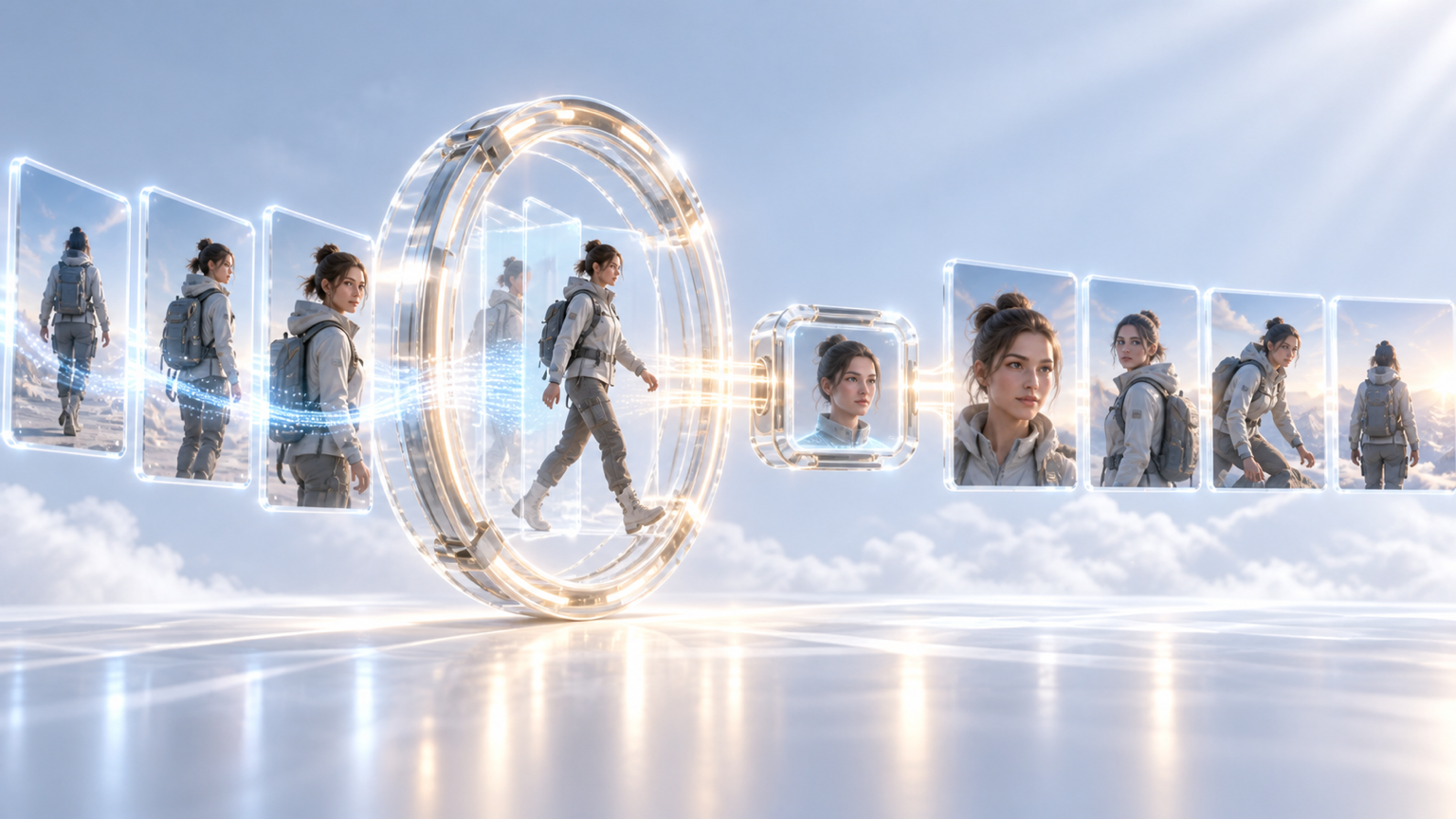
The hardest thing in AI video for client work is keeping a character consistent: the same face, wardrobe and feel across scenes, angles and lighting. Prompting alone drifts. The production answer is a video LoRA, and the important detail is how it is trained.
Train on video, not just frames
The key advance in recent video LoRA training is that it runs on video data natively rather than on still frames, so the adapter learns real motion and temporal consistency from the start, not just a look, but how a subject moves. An image-trained LoRA can hold an appearance in a single frame and still fall apart in motion; a video-trained one is built for the thing that actually breaks.
Use identity training for characters
An identity-focused (IC-style) LoRA trains a character from reference images and then generates video where that character holds its appearance across scenes, angles and lighting. This is the mechanism behind "the same person in every shot," and it is what turns a one-off good generation into a reusable, on-model character.
Go beyond faces
Video LoRA training is not only for characters. You can train branded visual styles, colour palette, lighting, grain, and even specific motion patterns like signature camera moves or animation styles. For a studio, that means a client's whole visual language, not just a mascot, can be encoded and reused.
Keep your weights portable
Train a LoRA, then run it wherever your pipeline runs: in ComfyUI, self-hosted locally, or via LoRA-powered endpoints on a cloud provider. Weights you can export and own mean no lock-in and no closed ecosystem holding your character hostage.
Treat training as a burst workload and the LoRA as IP
Training is periodic and VRAM-heavy, the classic spiky job that suits burst capacity rather than a dedicated always-on card. And the trained adapter is valuable studio IP encoding a client's character or style, which belongs in a governed, versioned registry with clear licensing and access control, not on an artist's local drive. A character that stays on-model across an entire campaign is often the difference between a usable AI video pipeline and an unusable one.
More from the blog
- A Risk Ladder for AI in Documentary
Screenweaver's 8 October guide ranks five documentary uses of AI by risk, from archive restoration to a synthetic face, and pairs them with EU disclosure rules now in force.
- The B-Roll Gap: Generated, Selected, or Shot
Every cut eventually needs a shot that does not exist. AI can generate it or search a library for it, and stock libraries are answering with different rules. Here is how to choose.