Guides
A Risk Ladder for AI in Documentary
· RenderBob team
Screenweaver's 8 October guide ranks five documentary uses of AI by risk, from archive restoration to a synthetic face, and pairs them with EU disclosure rules now in force.
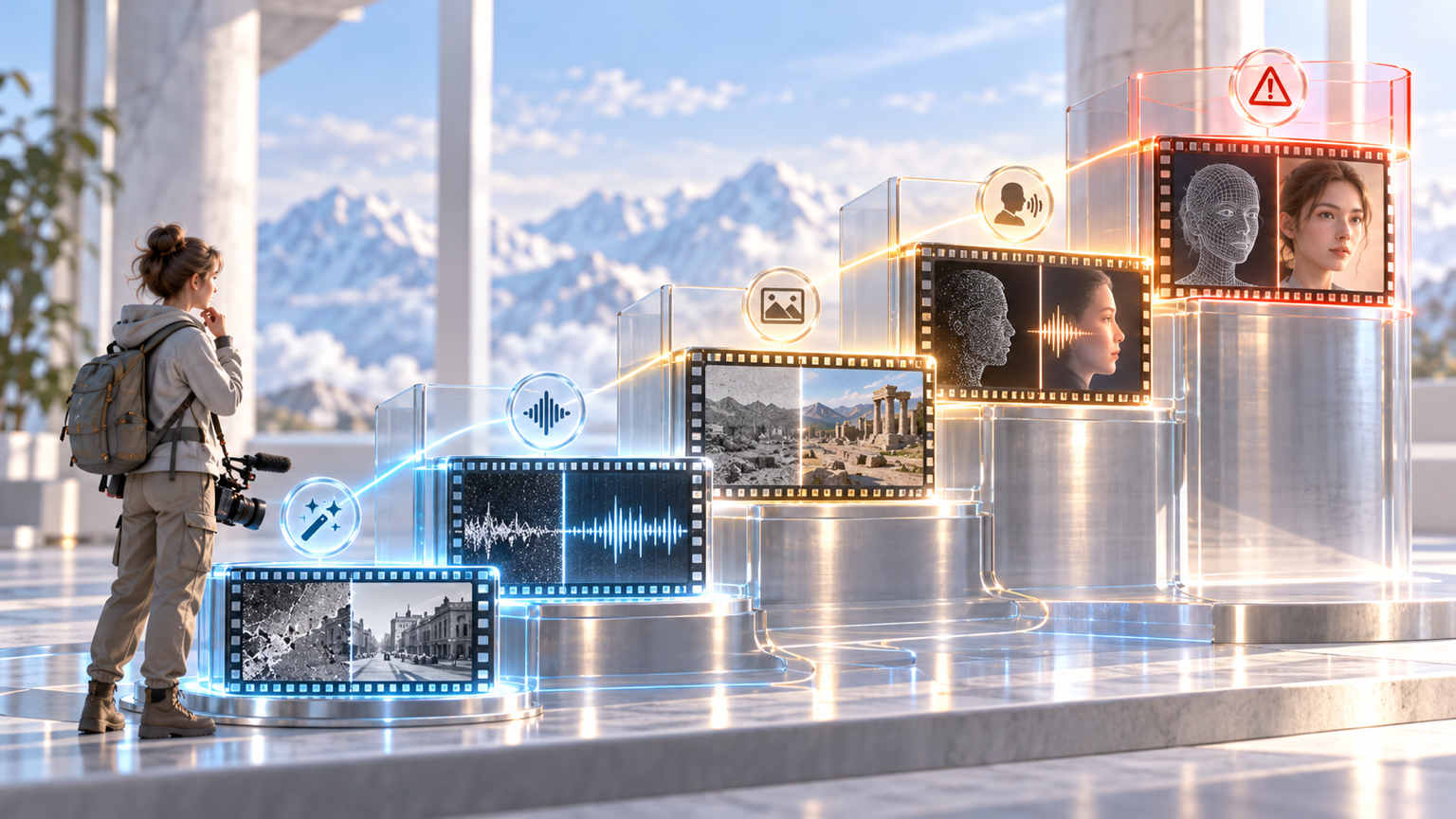
Documentaries sell trust. On 8 October 2026, Screenweaver published a guide whose short answer is that you can use AI in a documentary, and you cannot let viewers believe something generated was filmed. It ranks five uses by risk, asks for a log of every generated element and a label where viewers will see it, and says not to fake a real person's face or voice without consent. The ranking sits on the Archival Producers Alliance's September 2024 best practices for generative AI in documentaries.
Restoring archive
Denoising, stabilising, or upscaling a scan sits at the bottom. Screenweaver rates it low: a note in the credits, and a label if the restoration changes what the source is. The line the guide draws is specific. Turning a still photograph into a moving image implies a film camera was there.
Illustrative B-roll
Waves on rocks, an oil lamp, fog on a coast. Low to medium. Generic atmosphere claims nothing particular about a real event. Disclose it in the credits and the cue sheet, and put an on-screen label on the shot if a viewer could take it for archive.
Reconstructing events nobody filmed
A storm night in 1911 with no footage is the guide's high-risk example. Label every such sequence on screen, and record it in the cue sheet, the credits, and the platform settings. The more specific the claim a generated image makes about the real world, the louder the disclosure should be.
Synthetic voices
An invented narrator is a credit. A real person's voice, including a voice reading words they wrote and never spoke, is high to very high. It needs documented consent and an on-screen label.
Synthetic faces of real people
This is the top of the ladder. Screenweaver's position is not to recreate an identifiable person's face or voice without consent. Even with consent, the guide asks for an on-screen label and legal review.
The regulatory backdrop
The guide cites Article 50(4) of the EU AI Act: deployers who generate or manipulate a deepfake image, audio, or video must disclose it, with that duty applying from 2 August 2026. Works that are evidently artistic, creative, or fictional face a lighter obligation. A documentary presents itself as real, which makes the lighter treatment a poor fit. Netflix's partner guidance points the same way, telling productions not to generate content that could be mistaken for a real event or person.
General information, not legal advice. Requirements vary by territory and platform.
Keep a generation log
For each element, record the tool and version, the prompt, the date, the references and their rights, and where the clip appears. The Alliance's cue sheet is the version deliveries already understand, because it resembles a music or archive cue sheet. Write it while you generate. Rebuilding it at delivery is how the answer gets lost.
Decide the rung before you generate
Write the disclosure rule for that use before the clip exists. Label a reconstruction on the shot itself, not only in the end credits. Films get excerpted. Then check the distributor and the platform. YouTube requires disclosure for realistic synthetic content that could mislead about a real person, place, or event.
Insurers and broadcasters are starting to ask for this paperwork. Documentary has always reconstructed events. Generation changes how convincing the reconstruction can look, so the label has to travel with the shot.
More from the blog
- The B-Roll Gap: Generated, Selected, or Shot
Every cut eventually needs a shot that does not exist. AI can generate it or search a library for it, and stock libraries are answering with different rules. Here is how to choose.
- A Character Bible for AI Filmmaking: Keeping a Cast Distinct Across Shots
Keeping one generated character consistent is hard. Keeping three distinct in the same frame is harder. A character bible has to solve both before the scenes get built.