Case study
Banderas, Paris, and an AI Studio: What Utopai's Cortés Shows About Hybrid AI Production
· RenderBob team
Antonio Banderas will play Hernán Cortés in Cortés, an AI-enabled historical epic in production in Paris. Variety credits Paul Mignot as director.
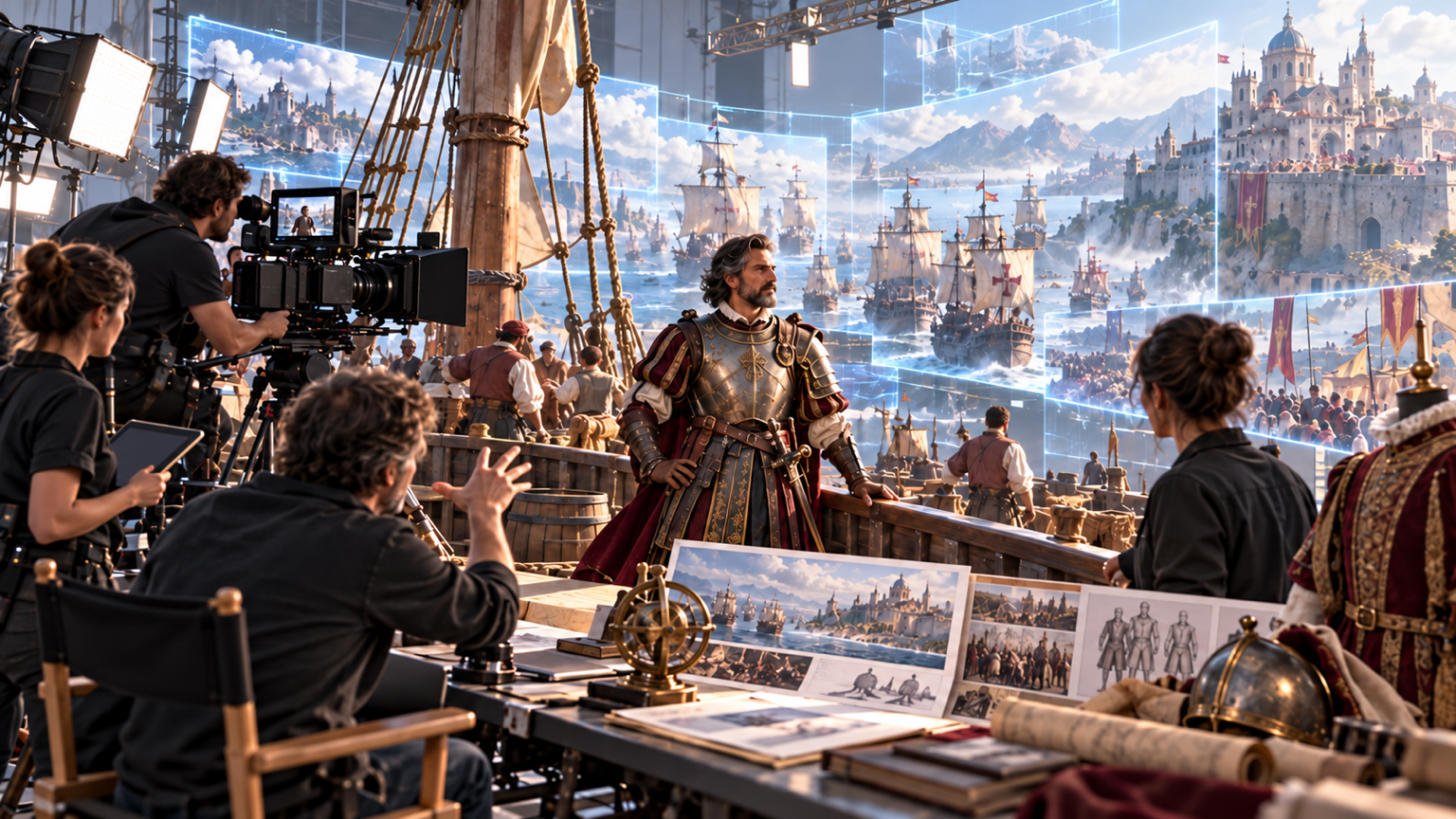
Antonio Banderas will play Hernán Cortés in Cortés, a historical epic reported as powered by AI and in production in Paris.
What is reported
Variety reports that Banderas stars, from a screenplay by Nicholas Kazan, with Utopai Studios and Ex Machina Studios co-producing. The film is in production in Paris. Release is expected next year, with no date. Variety and Utopai's project page credit Paul Mignot as director. Another report named production designer Kirk Petruccelli as set to make his directing debut, so the early coverage did not agree. Budget, and cast beyond Banderas, are not reported.
How Utopai says it works
Screen Global Production reported on 12 October that Utopai has 25 original projects in development and production, and a proprietary system called PAI for long-form work. Variety says Cortés, the animated adaptation The Most Serious Fart, and the live-action feature Half Moon are set for release next year, and that Journey to the West: The Lost Five Hundred Years is a fully AI-generated film made with the Chinese company Huace.
An Asia Business Daily profile from 9 September describes the AI use as selective and different on each project:
- Cortés. AI helps build large scenes that would be costly to produce conventionally.
- Half Moon. A Korean-German co-production shot in a traditional way, with AI limited to some visual elements.
- The Most Serious Fart. A hybrid, with AI in production design, storyboards, and animation.
- Journey to the West: The Lost Five Hundred Years. AI animation is the main method.
That profile was machine-translated. It calls Utopai the world's largest independent AI-native film and TV studio, and it cites Forbes for a valuation of roughly $1 billion as of May. Both are second-hand. Check them against a primary source before repeating them.
A star on a set, scenery at another scale
The production being described is a hybrid: a human star on a physical set, with generative tools used for scale and scenery. For a producer, the practical questions are the performer's agreement, which today's Cage piece covers, which scenes are generated, and how those scenes are labelled.
What to watch
Whether Utopai publishes a breakdown of generated versus filmed material for Cortés, how the film is described at release, and whether other stars sign on to AI-assisted epics.
More from the blog
- Critterz and the Retired Model: A Feature-Length Lesson in Tool Dependency
Critterz was pitched as an AI-assisted animated feature in about nine months for around $30 million. Its Cannes story is what happens when the video model in the pipeline is shut down.
- Wan 2.2 on a 6GB Card: A Real Low-VRAM Case Study
A community Wan 2.2 14B workflow generates a second of video on an RTX 3050 6GB in under five minutes. Here is the stacked technique set that makes that possible.