Technical
SplatPilot Turns Blender Scenes Into Gaussian Splats on Your Own GPU: Cameras, Coverage Maps and Three Export Formats
· RenderBob team
SplatPilot renders a Blender scene, trains a Gaussian splat on your GPU and imports it back. The timings are the developer's, on one Classroom scene with an RTX 4070.
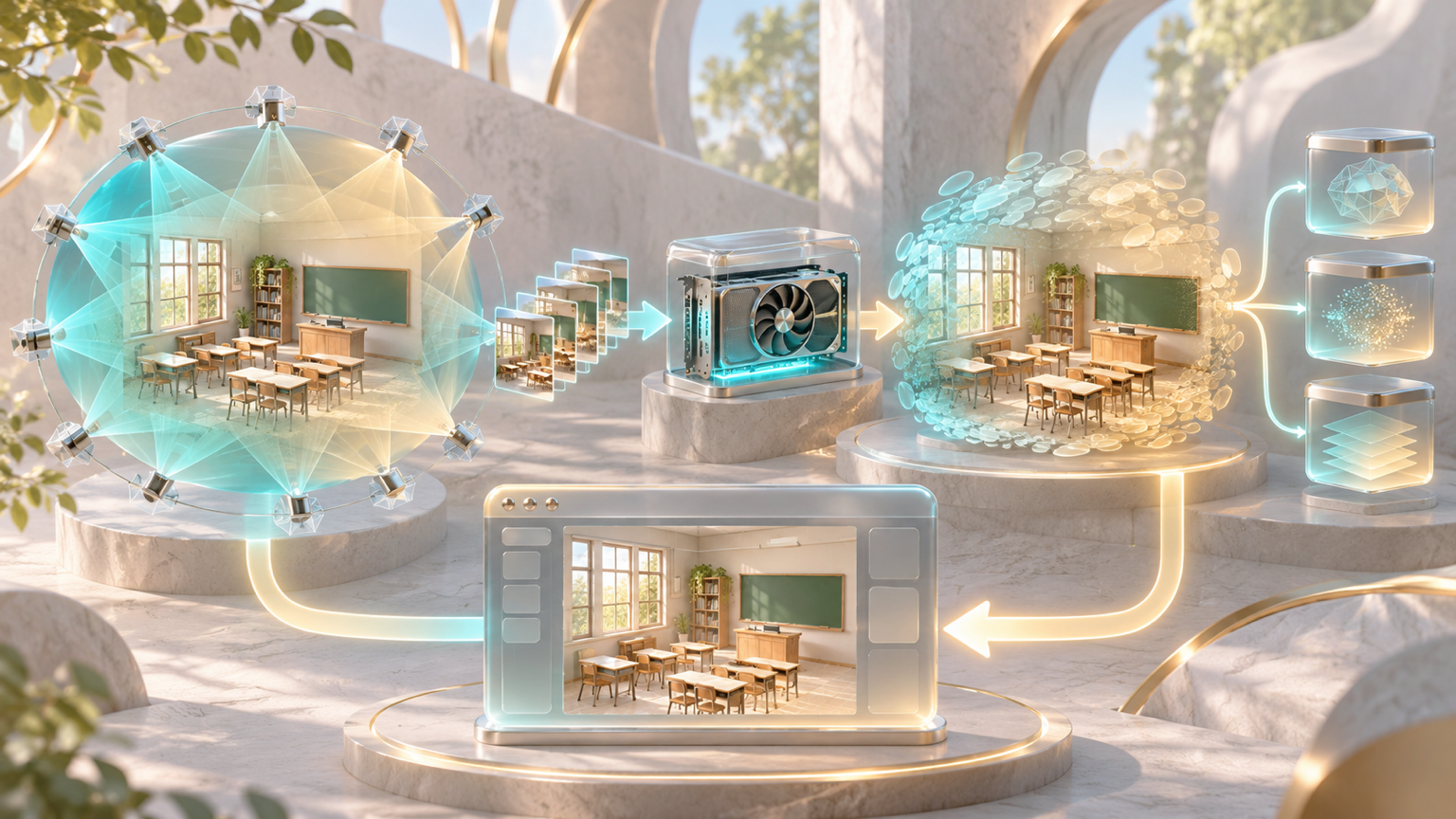
SplatPilot is a Blender extension that renders views of a scene, trains a Gaussian splat locally on the GPU and imports the result back into Blender. Digital Production covered it on 23 November. The article relies on the developer's published benchmarks and does not say the publication tested the tool.
What it does
- Capture. Object, Indoor and Outdoor modes place cameras automatically. Users can add their own cameras or set a focus point. A coverage map grades surfaces from Good to Unseen so blind spots can be fixed before rendering.
- Estimates. Before a run it estimates GPU memory, storage and duration. A Measure action times six test renders to refine the numbers.
- Training. Pausing and resuming, checkpoints every five minutes, and an Improve command for more iterations.
- Outputs. PLY, SOG and SPZ files. SOG and SPZ are much smaller than PLY, which has the broadest viewer support. It can also export COLMAP or transforms.json datasets for other trainers.
Limits and requirements
- It captures one moment, so animated geometry is not exported as an animated splat.
- There is no macOS build. Without Vulkan it can create a dataset but cannot train locally.
- It needs Blender 5.3 or newer, 64-bit Windows or Linux and a Vulkan-capable GPU. The developer estimates about 1 GB of VRAM for Standard and 3 GB for High. These are workload estimates, not minimum specifications.
Developer benchmarks
On a Classroom scene with an RTX 4070 using Cycles, the developer reports about two minutes for Draft, roughly 19 for Standard and about 61 for High. These are vendor figures.
Licence and price
GPL-3.0-or-later with full source included. Training is local, and no account or licence server is documented. A Personal licence is US$19 for one person and a Studio licence is US$42 for up to five.
Capture from a scene you already built
Rendering from a scene you already built skips the photo capture that photography-based splats need. The coverage map shows where the camera set missed before you spend the render time.
Testing it on your own scene
- Start with Draft to check the camera placement.
- Read the coverage map and fix Unseen surfaces.
- Use Measure before a long run.
- Export PLY first and check it in your viewer.
- Note your GPU and driver with the result.
What to watch
Independent tests on other GPUs, support for macOS, and viewer support for SOG and SPZ.
RenderBob 3 and this story
RenderBob 3 chooses local or cloud generation per clip. SplatPilot's training stays on the GPU in the machine running Blender.
More from the blog
- Runway API Adds Request Tags, a Workspace Members Endpoint and MiniMax H3 Image: What Cost Tracking Looks Like
Runway's API can tag generation requests and filter credit usage by those tags. The notes also add MiniMax H3 Image and a workspace members endpoint.
- Arnold's DLSS Viewport in Maya: Faster Look-Dev Previews, With One Warning About Imagers
Arnold 7.5.4.0 uses NVIDIA DLSS in the Maya viewport for faster look-dev previews. The accelerated view skips Arnold imagers, including colour corrections.