News
SAG-AFTRA's 2026 Television Animation Agreement: The AI Terms in Plain Language
· RenderBob team
SAG-AFTRA members ratified the 2026 television animation agreements on 29 October. Dubbing with a voice replica needs consent on pictures that start principal photography from 1 July 2027.
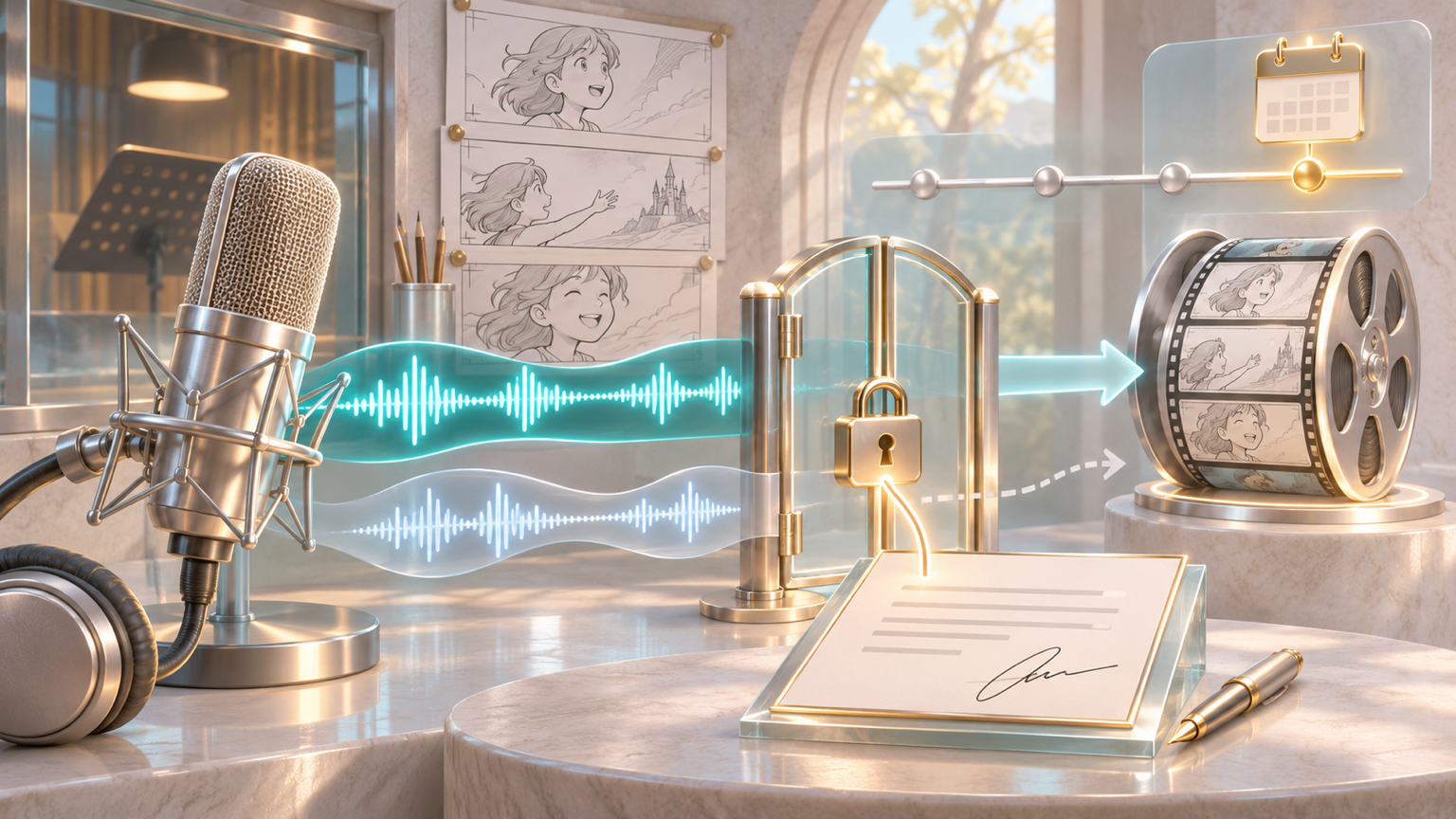
This follows our earlier note on the 2026 guild deals. Loeb & Loeb's quick take of 6 November still called SAG-AFTRA's television animation agreement tentative. The union's own referendum booklet, dated 8 October, was the summary members voted on, and the AMPTP said on 29 October that members had ratified the television and basic cable animation agreements through 30 June 2030. The terms below are from that booklet, not from the full agreement.
What the union summary says
- Dubbing. The previous contract let a producer use a digital replica to put a performance into another language without further consent. The new summary reverses that for pictures that start principal photography on or after 1 July 2027.
- Independently created replicas. A replica the producer did not make, such as one the actor already had, now has a floor of the minimum session fee. Residuals are due if that use would have earned residuals for a natural voice.
- Replicas without a scan. A replica made from the session recording, without a separate scan, still counts as an employment-based digital replica, with the protections attached to that label.
- Security. Producers must limit access to people with a business reason, and use commercially reasonable efforts against unauthorised access, use or copying.
- Synthetic performances. Notice and bargaining still apply when a generative system supplies a performance that is not a hired actor and is not a recognisable person. Producers also say they strongly favour human performance, and that they do not intend to use a synthetic in a human role unless it brings significant additional value over what a digital replica can do.
- Training. If a producer licences performances made under the agreement to an outside company, for pay, to train a public commercial generative system, the producer must notify the union in writing and, on request, meet to discuss the licence, including any payment.
What is still missing
The booklet is a summary. It does not set a dollar amount for the minimum session fee, and it does not print the full contract. Most terms take effect on the Sunday after the AMPTP receives notice of ratification, unless a clause names its own date. The dubbing rule has its own date, 1 July 2027, so a production already underway is not on the same clock as a picture that starts principal photography after that day.
What an animation producer can do now
Animation voice work is one of the first places a replica can stand in for a performer in a new language. The booklet gives a producer a short list of records to keep.
- Keep consent records for any voice replica, with scope and dates.
- Separate dubbing from new performances in the contract, and note the 1 July 2027 principal-photography line.
- Note any training licence, who is paid, and that the union must be told.
- Read the full text when it is posted before treating the booklet as the last word.
What to watch
The full agreement text, the Sunday the general terms actually start, and the published minimum session fee.
RenderBob 3 and this story
RenderBob 3 keeps references and prompt logs with the studio, so a producer can find which voices, likenesses and sources went into a generated clip when a consent question comes up.
More from the blog
- After Sora: Kling's Revenue, Funding and IPO Plans, as Reported on 17 November
Jumpstart's 17 November piece, republished by TechNode, says Kuaishou is spending more on Kling after OpenAI shut Sora down. The revenue, funding and IPO figures are second-hand.
- Seedance 2.5 Flash Launches at About 0.99 Yuan per Second: What the Cheaper, Faster Tier Offers and What Is Not Yet Confirmed
Volcano Ark prices a 5-second 720p Seedance 2.5 Flash example at 0.99 yuan a second. The same page marks 1080p and 4K unsupported for Flash.