News
Edit the Footage You Have: Prompt-Based Video Editing Reaches the Timeline
· RenderBob team
Models that rewrite real footage from a text instruction now sit beside the timeline. Aleph 2 and Kling O1 can repair a shot you already have.
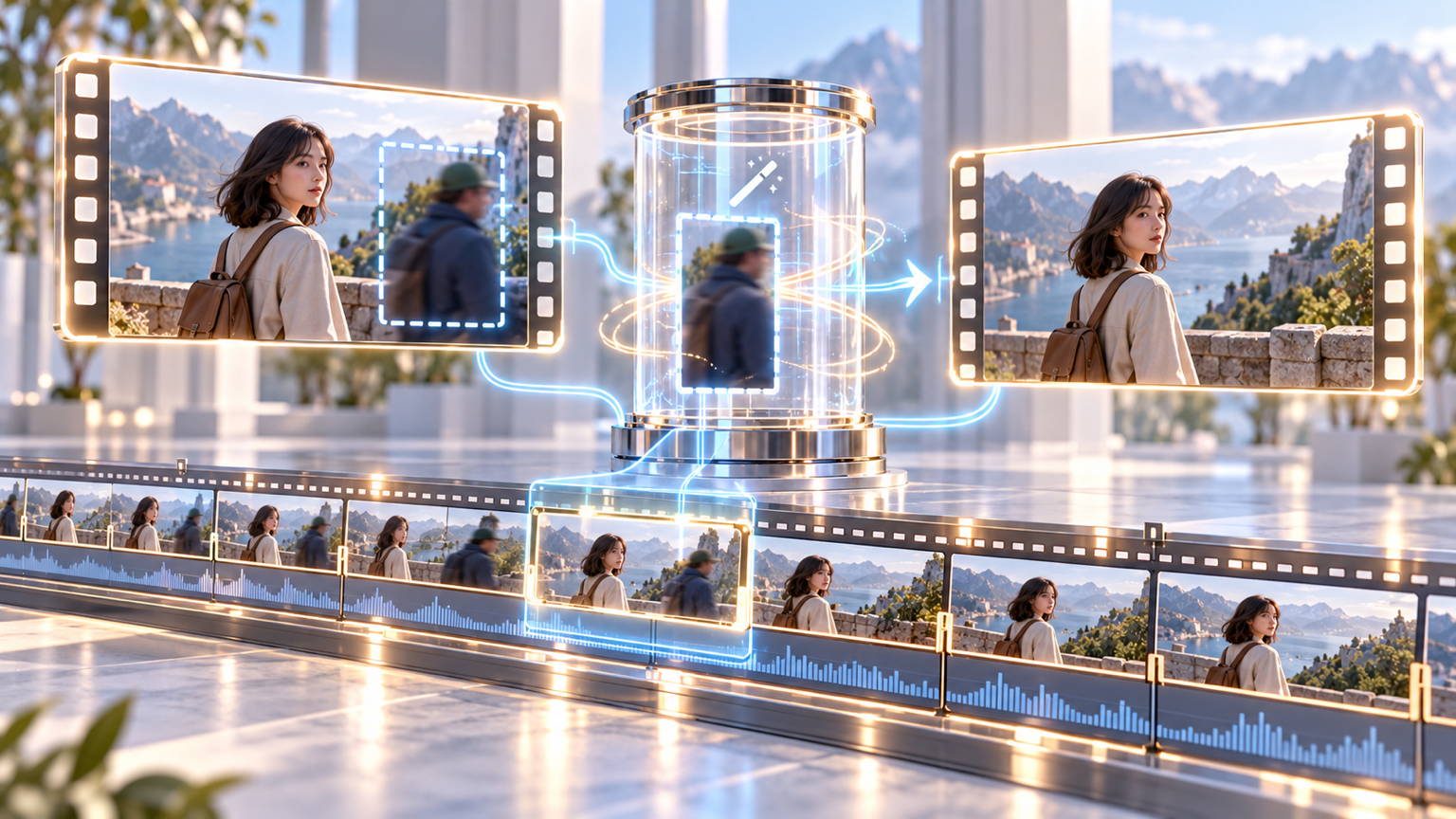
Most AI video coverage is about generating clips from nothing. A second family of models does something closer to what editors need on a bad day: take a real shot and change it.
What the tools do
Runway's Aleph, introduced in July 2025, edits existing footage from a text instruction rather than generating a clip from scratch. Its second version, released in May 2026, accepts clips up to 30 seconds, takes up to five keyframe images as guidance, and returns a result of the same length at up to 1080p. Documented uses include product swaps, object removal, new backgrounds, restyling, and multi-shot sequences, with the original motion, audio, and scene structure left intact. A current model roundup notes that it now runs in a Runway panel inside Premiere Pro and After Effects, so the edit happens beside the timeline instead of in a separate browser tab.
Kling's O1, released on 1 December 2025, is billed as the first model to combine text, images, and video as inputs for editing, taking up to seven references at once. Kuaishou's internal benchmarks claim it beats Runway's earlier model on video transformations. That is a vendor claim, and it has not been independently confirmed. Recent comparison guides also name Kling 3.0 Omni, Luma's Ray3 Modify, and Google's Omni Flash for the same job.
Why this matters for B-roll
The classic gap is a shot that does not exist. A more common cousin is a shot you have, with the wrong sign in the background, last year's product, or a stranger walking through frame. Editing models turn that second problem from a reshoot into a prompt. They can also restyle mismatched clips so a stock library shot sits better against your own footage.
The limits
Clip length is still short compared with a scene: 30 seconds at best, 3 to 10 seconds for some models, and the original Aleph used only the first five seconds of an upload. Output from Aleph 2 tops out at 1080p, so a 4K master would need conforming afterwards. Results vary and need a frame-by-frame look, especially around hands, text, and edges.
Disclosure
Changing real footage is a different act from inventing new footage. In documentary or news-adjacent work, an object removed from a real scene is an alteration viewers may care about. Disclosure duties for realistic synthetic or altered content apply in several places. The EU AI Act's Article 50 obligations have applied since 2 August 2026, and platforms such as YouTube have their own rules. Keep the untouched original, log the edit, and label it where it matters.
General information on disclosure duties, not legal advice.
What to watch
Longer durations, and resolution that survives the round trip, would move these tools from fixing shots to rewriting scenes. Until then they are a fast way to repair and adapt material you already own.
More from the blog
- Higgsfield Says AI Video Now Runs Past 10 Minutes: What an OpenAI Customer Story Does and Doesn't Show
An OpenAI customer story from 13 October says Higgsfield can now produce AI video longer than 10 minutes using GPT-6 Astra. The claims are the company's, and no independent test has been published.
- Disney Bids $20 Million for a License to Character.AI's IP: What the Stalking-Horse Deal Does and Doesn't Say
Character.AI filed for Chapter 11 on 12 October, and Disney Worldwide Services is the opening bidder at $20 million for a non-exclusive, perpetual licence. Higher bids can still come in.