Workflow
A Distillation-First Motion Workflow: Iterate Local, Finish on Burst
· RenderBob team
A four-step distilled model and a full-quality parent should not share the same jobs. Use them in sequence.
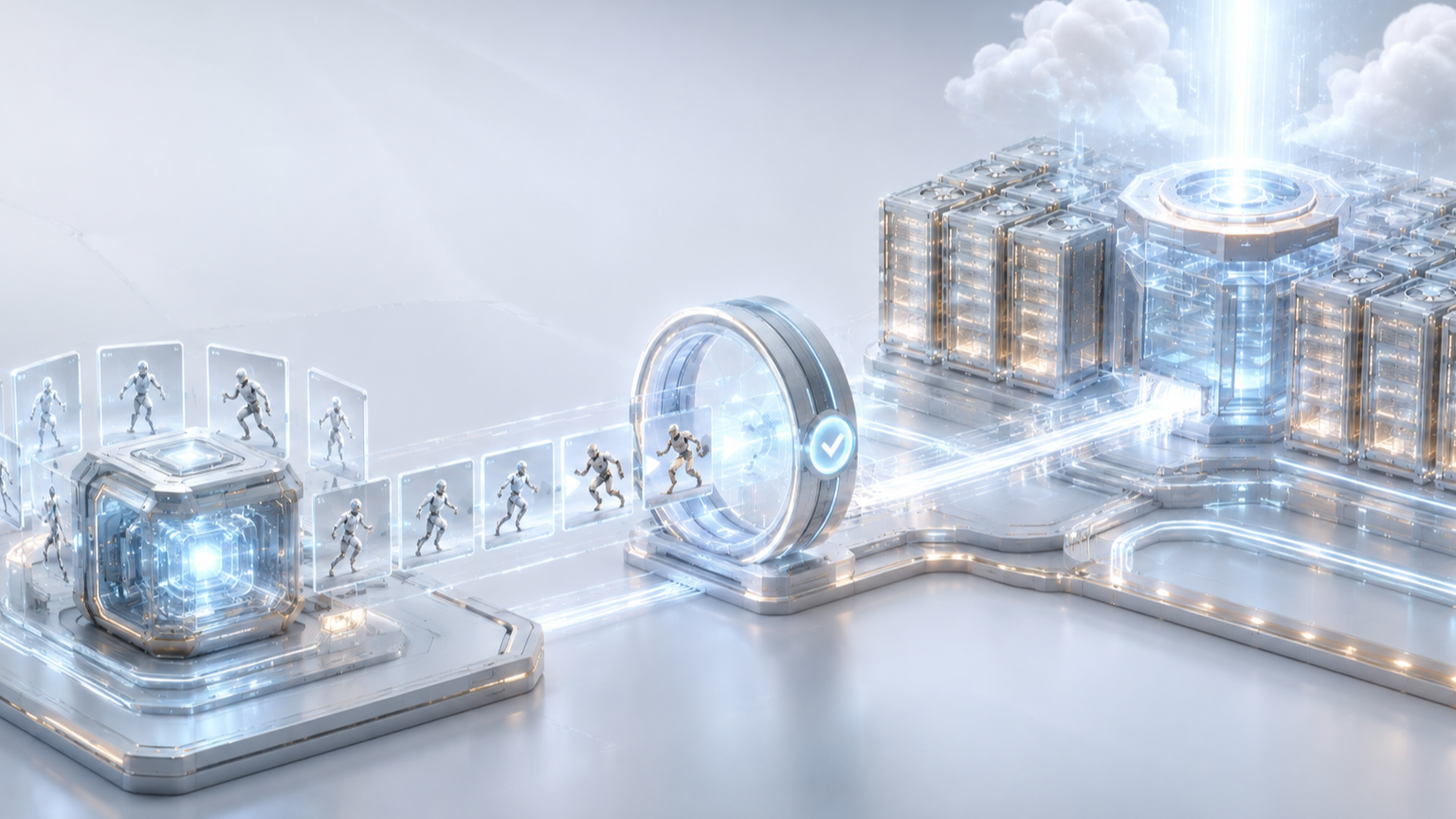
A four-step distilled model and a full-quality parent should not share the same jobs. Use them in sequence.
Iterate on the distilled model, locally
A four-step distilled model like FastH3 runs roughly 7x faster than its full-quality parent, while staying close enough in look for creative decisions. Use it for everything exploratory: blocking motion, testing prompts and conditioning, showing a client a direction. This runs on owned discrete cards, gives near-immediate feedback, and costs nothing extra.
Lock the creative decision before you spend quality
Do not render full-quality passes while you are still deciding. Do all your deciding on the fast distilled model. Only when the shot is approved in look and timing do you move up to the expensive version. Most renders in any project are iterations, not finals. That split can cut a project's heavy render volume by most of it.
Finish on the full model, on the right hardware
The approved shot gets its final pass on the full-quality model at delivery resolution. This is the memory-hungry, time-hungry job. Route it to hardware that fits it: a unified-memory machine for oversized jobs, or a cloud burst node provisioned for the pass, rather than forcing it onto the same discrete card you iterated on.
Interpolate instead of rendering every frame
Where framerate matters, generate at a lower framerate and use frame interpolation or RTX Video Frame Generation to multiply it, rather than paying to render every frame at full quality. Fewer generated frames, same delivered smoothness.
Upscale as a separate, routable stage
Keep the upscale pass separate so it can run on hardware sized for it and doesn't collide with the sampling pass's memory spike.
Iteration stays cheap, fast, and local, where you make hundreds of versions. Finals stay expensive, high-quality, and routed to hardware that can hold them. Distillation makes the exploration nearly free. A local-plus-cloud pipeline puts the delivery pass on hardware that can actually finish it. The render bill reflects the finals, not the exploration.
More from the blog
- Two Lanes of AI Editing: Mechanical Cleanup and Narrative Assembly
AI editing tools split into cleanup that follows story decisions and assembly that proposes them. A third question, local or cloud processing, now cuts across both.
- "Just Regenerate": The Bad-Seed Workaround Culture in AI Video Editing
While reference-guided video stays unreliable, working practice is blunt: do not commit a clip until you have looked, delete a stuck result, and switch models when one keeps missing.